
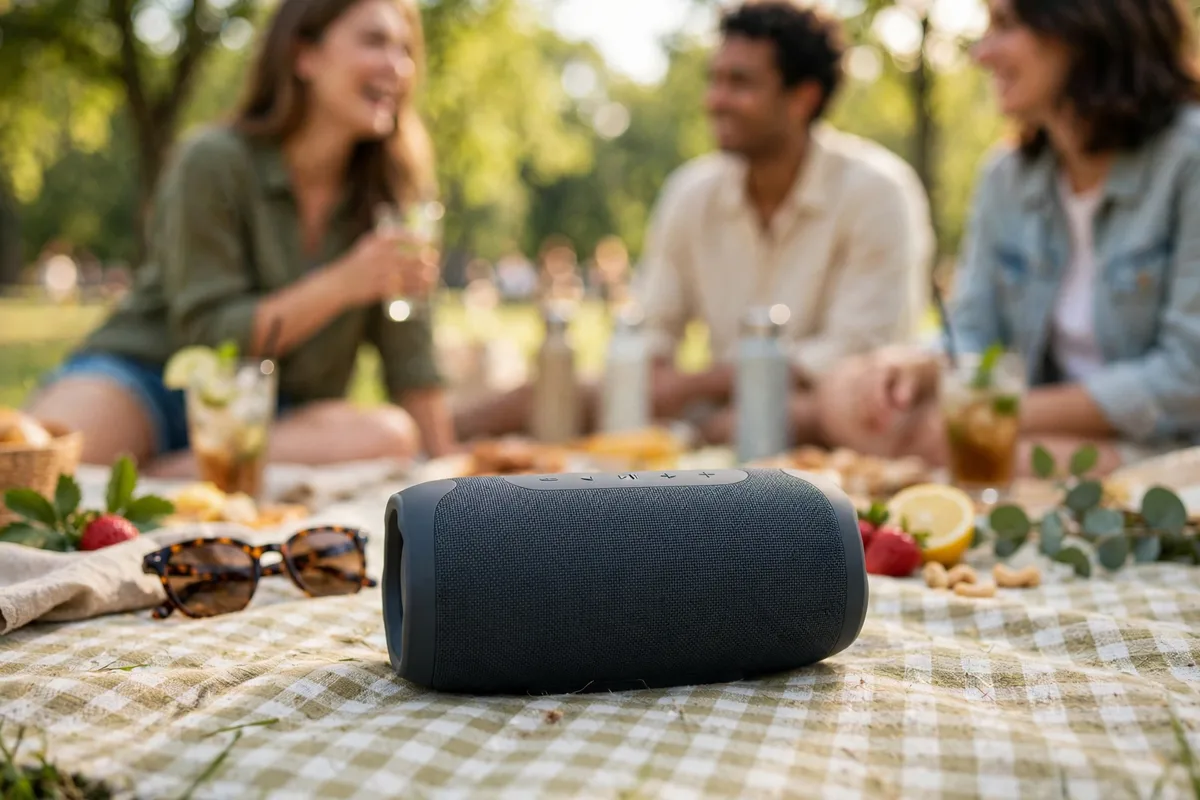
Bluetooth speakers split into two very different jobs: the pocket speaker you clip to a bag, and the room-filling speaker that anchors a gathering. Our five picks cover both, from a palm-sized speaker that weighs less than a phone to a floating, saltwater-proof outdoor speaker with a built-in emergency alarm. Every one of them is waterproof, every one pairs with a phone in seconds, and each earns its place for a different kind of listening.
Last updated November 2026 — product details and plan pricing re-verified. We don’t publish live Amazon prices; check the current offer on the product page.
Quick Comparison
| Product | Best For | Key Spec | Price Tier |
|---|---|---|---|
| JBL Flip 7 | Best overall | 35W, IP68 waterproof, up to 14 hours playtime (16 with Playtime Boost), Bluetooth 5.4, Auracast | Mid |
| JBL Go 4 | Best pocket speaker | 4.2W, IP67 waterproof, up to 7 hours playtime, Bluetooth 5.3, Auracast | Budget |
| Sony SRS-XB100 | Best compact speaker | IP67 waterproof, up to 16 hours battery, versatile strap, hands-free calling | Budget |
| Soundcore Boom 3i | Best outdoor speaker | 50W, IP68 waterproof, floats, saltwater resistant, up to 16 hours playtime, Bluetooth 5.3 | Mid |
| Marshall Emberton III | Best battery life | 32+ hours playtime, IP67 waterproof, Bluetooth 5.3 LE, 360° True Stereophonic sound | Premium |
Based on specifications, owner feedback and comparative research — not hands-on lab testing. Prices shift constantly; check the live price before you buy.
Best Overall: JBL Flip 7
The Flip 7 is the current generation of the speaker that defines this category — JBL’s own support pages list the Flip 6 as its predecessor, and the upgrade is meaningful. It delivers 35 watts through a race-track woofer and a dedicated tweeter, carries an IP68 waterproof and dustproof rating, and runs up to 14 hours on a charge, or up to 16 hours with Playtime Boost engaged. Bluetooth 5.4 and Auracast support mean you can pair two Flip 7s for stereo or link an unlimited number of compatible JBL speakers for simultaneous playback, and the interchangeable PushLock system lets you swap between the included wrist strap and carabiner.
The honest trade-offs: there is no built-in microphone, so the Flip 7 cannot take calls or pass through a voice assistant, and no USB-C charging cable is included in the box. Playtime Boost stretches battery life by trimming bass and EQ, so the headline 16-hour figure comes with a sound compromise. And while IP68 is the strongest rating here, it is still a speaker that rewards drying off after a swim rather than being left wet in a bag.
Who it’s for: anyone who wants one speaker that does everything well — loud enough for a gathering, tough enough for a pool or a hike, and current enough that it will not feel dated next year. If you buy one Bluetooth speaker, this is the default choice.
Best Pocket Speaker: JBL Go 4
The Go 4 is the smallest serious speaker JBL makes: 3.7 by 3.0 by 1.7 inches, weighing 0.19 kilograms, with a redesigned integrated loop that clips to a bag or a belt. It still manages 4.2 watts of JBL Pro Sound with punchy bass for its size, an IP67 waterproof and dustproof rating, and up to 7 hours of playtime. Bluetooth 5.3 with Auracast support means two Go 4s pair for stereo, and the customisable equaliser in the JBL app lets you tune the highs, mids, and lows to taste.
Physics sets the limits. A speaker this small cannot produce deep bass or fill a room, and 7 hours is the shortest battery life in this roundup — fine for a day trip, tight for a full weekend away. It is a personal speaker, not a party speaker, and anyone expecting the Go 4 to anchor a gathering will be disappointed.
Who it’s for: travellers, hikers, and anyone who wants music clipped to a bag rather than carried in a hand. It is also the natural stocking stuffer of this roundup — small, colourful, and genuinely useful.
Best Compact Speaker: Sony SRS-XB100
The SRS-XB100 is Sony’s answer to the pocket speaker, and its headline advantage is battery life: up to 16 hours, more than double the Go 4, in a speaker that still fits in a bag or a cupholder. It carries an IP67 waterproof and dustproof rating, a versatile strap for carrying or hanging, a built-in microphone with echo cancelling for hands-free calling, and a sound diffusion processor with a passive radiator that spreads sound more widely than its small size suggests. Two units can be stereo-paired, and it charges over USB-C.
The trade-offs are modest but real. At roughly 9.7 ounces it is heavier than the Go 4, and its bass is limited — the sound diffusion processor widens the soundstage but cannot conjure low end from a compact driver. It also has no companion app or EQ control, so what you hear is what Sony tuned. For most listeners that tuning is pleasant; for tweakers it is a dead end.
Who it’s for: anyone who wants the longest battery life in a genuinely pocketable speaker, plus the ability to take a call on it. It is the best compact pick for long days out — beach, hike, or garden — where charging is not an option.
Best Outdoor Speaker: Soundcore Boom 3i
The Boom 3i is built for water in a way no other speaker here is. It is IP68 waterproof and dustproof, saltwater resistant, and it floats — its auto-upright floating design keeps the drivers facing forward even in active water. Soundcore rates it at 50 watts with BassUp 2.0, up to 16 hours of playtime, and Bluetooth 5.3 with TWS stereo pairing. The outdoor extras are genuinely useful rather than gimmicks: a 96 dB emergency alarm audible up to 100 metres, a voice amplifier for broadcasting messages, Buzz Clean mode to shake dust and debris out of the drivers, and an RGB light show for evenings outdoors.
The trade-offs: at 780 grams and just over 8 inches long, it is portable but not pocketable — it is a water-bottle-sized speaker that needs a bag or a strap, not a jacket pocket. It has no power-bank function to charge a phone, and its 16-hour battery, while solid, is not class-leading for a speaker this size. The floating design works in a pool or calm water; in rough water it is still a speaker that can drift away.
Who it’s for: kayakers, boaters, beach-goers, and campers — anyone whose speaker is likely to end up in the water. If your listening happens near a pool, a lake, or the sea, the Boom 3i is the only pick here designed for exactly that.
Best Battery Life: Marshall Emberton III
The Emberton III’s headline number is 32-plus hours of playtime on a single charge — roughly double every other speaker in this roundup — with a 20-minute quick charge delivering around 6 hours of playback. It pairs that endurance with Marshall’s signature styling, 360° True Stereophonic sound from two full-range drivers and two passive radiators, an IP67 dust and waterproof rating, Bluetooth 5.3 LE with Auracast support, and a built-in microphone for hands-free calls. The multi-directional control knob on top handles play, pause, skipping, and volume with one hand, and the Marshall Bluetooth app adds EQ presets and firmware updates.
The honest caveats: independent comparisons note the Emberton III sounds very close to its predecessor, the Emberton II, with the microphone and Bluetooth LE audio as the main additions — so the Emberton II is worth considering if you find one at a lower tier. There is no aux input and no power-bank function, and at roughly 0.67 kilograms it is the heaviest compact speaker here. It is also the premium-priced pick in this roundup, and its retro styling is a statement not everyone wants on a hike.
Who it’s for: anyone who hates charging things — multi-day trips, long weekends, and households where the speaker lives on a shelf and gets used daily without ever seeing a cable. If battery life is the deciding factor, nothing else here comes close.
Bluetooth Speaker Buying Guide
Start with size and where the speaker will live. A pocket speaker (Go 4, SRS-XB100) is for one person on the move; a mid-size speaker (Flip 7, Boom 3i, Emberton III) is for a room or a group. Buying a pocket speaker to fill a backyard is the most common disappointment in this category, and buying a heavy outdoor speaker to clip to a daypack is the second.
Waterproof ratings are worth reading properly. IP67 means dust-tight and protected against immersion up to 1 metre for 30 minutes; IP68 means the same dust protection with deeper or longer immersion as specified by the manufacturer. Both ratings here are tested in fresh water under laboratory conditions — saltwater, soapy water, and chlorinated pool water are harsher, and only the Boom 3i is explicitly rated saltwater resistant. Rinse any speaker with fresh water after pool or sea use, and dry it before storing.
Battery claims are measured at moderate volume, so treat them as best-case figures. A speaker rated for 16 hours at half volume may give you 8 to 10 hours at party volume. If long sessions matter, the Emberton III’s 32-plus hours is the only figure with real headroom; for everyone else, the practical question is whether the speaker survives a day out, and every pick here does.
Consider pairing and ecosystem features before you buy a second speaker. Auracast (JBL) and TWS stereo pairing (Sony, Soundcore) let two identical speakers form a stereo pair, and Auracast goes further by linking many compatible JBL speakers at once. Marshall’s Stack Mode links multiple Marshall speakers. If you already own one speaker from a brand, staying in that ecosystem for the second one is usually the smart move.
How we picked these: our recommendations come from published specifications, aggregated owner reviews, and comparative research across current review roundups — not hands-on lab testing. We have not personally played hours of music through each of these speakers. What we can offer is the pattern across thousands of owners: which speaker survives a pool, which battery claim holds up in practice, and which size actually fits the job. Price tiers are relative positioning, not quotes — check the live price before you buy.
Frequently Asked Questions
What is the best Bluetooth speaker overall?
For most people, the JBL Flip 7. It combines 35 watts of output, an IP68 waterproof rating, up to 14 hours of playtime, Bluetooth 5.4, and Auracast multi-speaker support in a size that still fits in a bag. It is loud enough for a gathering, tough enough for outdoors, and current enough to stay relevant.
What does IP67 vs IP68 mean for a Bluetooth speaker?
Both mean the speaker is dust-tight. IP67 adds protection against immersion up to 1 metre for 30 minutes; IP68 adds protection against deeper or longer immersion as specified by the manufacturer. In practice, either rating survives rain, splashes, and a drop in the pool — but both are tested in fresh water, so rinse the speaker after saltwater or chlorinated pool use.
Can I pair two Bluetooth speakers for stereo sound?
Yes, with matching models. Two JBL Go 4s or two Flip 7s pair for stereo, two Sony SRS-XB100s pair for stereo, and two Soundcore Boom 3i speakers pair over TWS. JBL’s Auracast goes further, linking many compatible JBL speakers for simultaneous playback. Different brands do not pair with each other.
How long do Bluetooth speaker batteries really last?
Manufacturers quote playtime at moderate volume, so expect less at party volume — a speaker rated for 16 hours may give 8 to 10 hours when played loud. The Marshall Emberton III, rated at 32-plus hours, has the most headroom in this roundup. If you need a full day of loud music, bring a charger or pick the longest-rated battery.
Can Bluetooth speakers go in the pool?
IP67 and IP68 speakers can handle splashes and brief submersion, and the Soundcore Boom 3i is designed to float. But none of them are meant to live underwater, and saltwater and chlorine are harsher than the fresh water used in lab tests. Rinse with fresh water and dry the speaker after pool or sea use.